Thursday, February 17, 2022

Namaste – the divine life in me greets the divine life in you.

Some time ago, I entered a classroom at Niagara University where I was teaching “froshies” the rudiments of the New Testament, focusing on the teachings of Jesus in the gospels. The classroom was located near the Campus Ministry office. In the corridor, I noticed a series of handmade posters promoting classical religious virtues. The one that really caught my eye highlighted the virtue of humility. It said something like this: humility is admiration for the gifts that God has given to others – reverence for God in others – recognizing and developing our own gifts for others. It seemed a bit prosaic for an inspirational poster, but it accomplished its purpose. So much so, that I pulled out the journal I always carry and recorded the sentiments expressed. It really accomplished its purpose when you realize that the year 1991 and I still refer to it. 

Too often when we hear the word humility, we think of how we ought to be self-effacing – diminish ourselves in the light of others. Here however, the word admiration opened for me a new way of thinking about humility. On seeing admiration in connection with humility, I began to recognize all the ways in which, being preoccupied with myself, I failed to stop and admire the gifts of others. I am happy to say the poster almost immediately made me admire the gifts of those around me, including my students!
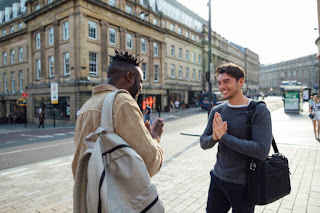
I’ve recalled that poster many times since, especially when I witness pitched battles over social issues. It is so amazingly easy to get drawn into confrontations over policies, structures, and outcomes when we confront the problems that face our communities. Regardless of which side we may take on a particular issue, we are all thinking about doing what we deem “good.” The problem emerges when we see anyone who questions or opposes us as a barrier to accomplishing that good. We come close to falling into what is known as a “technocratic paradigm,” where we treat others not as persons but as thing - as unruly “parts” of a mechanical assembly. But society is not a machine. It is something that we do with other people. Thus, church teachings are not exclusively about policies and plans. As Christians our “positions” must reflect virtues – the positive habits we form as we learn how to interact with others. To overcome the growing divisions in our communities, we may need something like what we might call social humility – something like what is rooted in the convictions the poster expressed.

To develop a sense of social humility, we must acknowledge that none of us can see the whole picture. None of us has a “God’s-eye view” of something as vast and complicated as society. This may seem like common sense, but it is especially important for Christians.

From the beginning, wanting to “be like gods” has been part of the human condition. This temptation grows stronger when we try to better society motivated by religious faith. If we believe we are doing God’s work, we can too easily believe anyone who opposes us opposes God. “Social humility” reminds us that situations are never that simple. Social humility asks us to admire that piece of the picture that God has given to others to see and that may be hidden from our eyes.

Another important aspect is rooted in our traditional teaching about conscience—namely, it is nearly impossible to snuff out one’s conscience entirely. No matter how poorly an individual’s conscience may have been formed over time, we believe that there is still a fundamental inclination placed there by God: to do what is good. Problems emerge, however, when we are mistaken about what the good genuinely is and what means we can use to achieve it. Even so, if we believe that we search for the good with some degree of clarity, and our opponent does not, we must still believe that our opponent also seeks what is good – as they see it. Then, there is something in their view that is good and thus worth admiring.

Finally, we believe that God created humanity to be one family. Family metaphors dominate the language of human relationships in Christianity. We grow accustomed to being addressed as “brothers and sisters,” that God is “our father,” and that Mary was the “mother” of the “son” who is the “brother” to us all. Our first response to others, then, should a response we would hope for in family relationships: no matter the conflict, the option of total rejection or destruction is off the table. This is not to say that family relationships cannot break down. Parents reject children, children reject parents. People become alienated from their own families. Even Jesus recognized that possibility. But the pain of such situations alerts us that this is not God’s design for us. Instead, we should seek to find the good in our brothers and sisters—and not just our biological ones – but everyone in God’s human family.

This admiration-first approach is not easy. We need to be aware of the particular “structures of sin” that we face in trying to cultivate such humility. One of the biggest problems we face today are the ubiquitous online forums that prioritize getting attention and rousing followers. It is always easier to cultivate humility when we come face-to-face with real, not virtual, people. We know all too well that even real-life social relationships can be infected by pride, hostility, and arrogance. But we also recognize it is harder to hate someone to their face.

This isn’t about being “nice” to everyone. It isn’t about trying to get the other person to be “nice” to us. It is about living out the gospel values of respect and an acknowledgement of the dignity of every human being, even those we may not “like.” 

To follow the Way of Love, as Jesus proclaims it, we must stand up for dignity. We should especially minister to those who suffer at the hands of those who fail to respect others’ dignity. Even so, we never have permission to fail in respecting the dignity of those on the “other side.”

Is that a path of foolishness? If we think in terms of maximizing outcomes, it certainly is. But the poster in the hall at Niagara U. reminds us why it is not foolish. It is a way of experiencing conflict that says to an opponent: “you are a Child of God, and nothing you do or say is going to make me stop trying to connect with the Child within you.” It is about admiring their basic dignity and finding their gifts, no matter what. In doing that, we can never truly lose.

Saturday, January 1, 2022

Where there is no vision . . .


Where there is no vision, the people perish: but he that keepeth the law, happy is he. [Proverbs 29:18 (KJV)]

Some have used this verse to emphasize the importance of vision in leadership: without a long-term plan—without a vision—people are doomed to wander aimlessly. I don’t think, however, that this is the essence of this verse. Another translation put it this way: “Where there is no revelation, people cast off restraint; but blessed is the one who heeds wisdom’s instruction.” (New International Version). In other words, when prophets fail to articulate the vision that God has for God’s people, the people will forget their purpose, who they are, and why God called them together into a community.

Vision in this verse refers to what a prophet sees in a dream, revelation, or prophetic utterance. Interestingly, the same word is used in another place where the writer bemoans the rarity of the word of the Lord and the scarcity of prophets to speak that word (I Samuel 3:1). A lack of vision, then, is a lack of God’s divine communication.

The Feast of the Epiphany begins a time when Scripture reveals “visions galore”: the dreams of the magi, the utterance of Simeon at the presentation in the temple, doves descending at the Lord’s baptism. And that’s only the beginning. The season goes on to manifest the identity of Jesus as the promised Messiah beginning with the wedding at Cana ends with the glorious vision of Jesus transfigured – a vision entrusted to Peter, James, and John – Jesus’ closest friends on Transfiguration Sunday.

These are all supernatural events. But the kind of vision we need is not miraculous. Rather, its key lies in the second part of the verse: he that keepeth the law, happy is he. Again, the NIV guides us: blessed is the one who heeds wisdom’s instruction.

In this sense, vision becomes the roadmap of what God wants us to do. It is God’s view of our future as those marked out as his own (BCP 308). Vision provides an answer to the question, “What should we do?” When what comes into view is from God, it is more than a dream – it is vision. Yet, if we fail to acquire clear vision then passion and confidence will be lacking and others might not see the value of faith in God. Even members of our own community may drift away – casting off restraint. We fail as a community of faith to bring Christ to all– the message of Epiphany.

Every good planner knows that vision isn’t everything. Every vision must result in a statement mission – and a mission must be reduced to its strategic goals. As we begin to emerge from our long COVID winter, we must recall the vision and the mission goals we established in VISION 20/20 – our Gran Sueno, our big dream. But even that is not enough. Just like the vision God had for ancient Israel, our mission is a living, developing thing. Grounded in unchangeable values, the strategies shift as we adapt to new circumstances.

Through the next year, we will lean into the vision God has given us and explore new ways to fulfill our mission to make it real in our world. Only with such a vision, and a dedicated effort to “heed wisdom’s instruction” will we confidently enter a new chapter in the life of St. Luke’s

Tuesday, December 28, 2021

Innocence and Suffering

Today the Episcopal Church remembers the “Holy Innocents,” the subject of the “Coventry Carol” so often heard at Christmas time. We remember the slaughter of “every make child two years and under” by King Herod because of his well documented ego and paranoia. Afraid that the “newborn King of the Jews” would usurp his throne, he had the children killed to eliminate his competition.


While in all likelihood, the children suffered little (a swift death is often merciful), the agony of the parents is without parallel. Even though I do not have children, I have been assured by members of my own family that there is no greater loss to be experienced than the loss of a child, regardless of their age. In many ways, the death of one’s child upsets the natural order – children are to outlive their parents – or so it is our common wisdom.

The fact remains that infant mortality has declined greatly in our society. The great pandemics (influenza, typhus, cholera) seem almost non-existent to most of us, even as one more rears its ugly head. These diseases claimed many innocent lives only two generations ago, before the advent of modern antibiotics. And now children may die for the decision not to vaccinate them. While the death of children may have been more common and even expected years ago, the sense of loss is no less poignant whenever and for whatever reason it happens.
 
We only need to see the evening news with images of the children now being infected with COVID, the children of Latin America at the southern border, those fleeing Northern Africa across the Mediterranean. So many children. so many innocent seeking only safety and a better life.

The message of this day, however, is that out of such horrible suffering, God can change things. Even though these parents suffered such tragic and profound loss, God delivered the Christ Child by a dream message to Joseph, who took the Child and his mother to Egypt to escape the tyranny of Herod. When the Child returns, he will be the salvation of the world and proclaim a kingdom of justice and truth that would outlast any attempt by Herod to assure his own power.

That hope must be ours today – as many children suffer needlessly because of greed, prejudice, and the lust for power in nations throughout the world. We listen to the promise of Christ and carry the message of his kingdom into our world. If we remain faithful to its values and its promise, we, too, may see the “mighty cast from their thrones” so that the lowly, the powerless and voiceless innocents of our world might then be “lifted up.”

Wednesday, December 1, 2021

Consider well and bear in mind

Furst Christmas Eve Family Service - 2015

Christmas is a time for nostalgia. One of my favorite music sources is Holiday Traditions on Sirius/XM, the satellite radio service. Bing Crosby, the Percy Faith Orchestra, Perry Como, Dean Martin, Ella Fitzgerald, Steve and Edie, and on and on. They all remind me of childhood days when we could not wait for the next Christmas album, sponsored by Goodyear or Firestone to arrive at our local Western Auto store. My dad would buy the album and we’d play it (and the ones before it in the series) over and over until the grooves would no longer track the needle on our stereo phonograph (Yes, I know. There are many who may read this and wonder what in the world I am talking about. Just ask your parents.)

Anyway, just hearing those classics brings memories of family traditions, Christmas tress toppled over by the cat as my mother completed decorating, gifts, and cookies – lots of cookies. And, of course, Midnight Mass.

These memories are always welcome and can create a comforting reverie. But those daydreams seldom recall the family tensions, arguments, or disappointments that accompanied those happy memories. As humans, we tend only to remember the good parts and try to sock the uncomfortable stuff away, out of sight and out of mind. If we are honest, though, we realize that music induced reveries are not reality. The good ol’ days weren’t always all that “good.” Perhaps there is a lesson here for us in the difficult days of our Christmas present.

The many months or the COVID-19 pandemic have been difficult and for many, deeply painful. Most of us continue to live with anxious spirits about when all this will end – when we can get back to what we account as “normal.” That time of “normal” may be what has become for us in the present, the good ol’ days.

But just like our nostalgic reveries, we  must remember that the old normal may not have been all that “good.” Our continuing response to the challenges of the pandemic are teaching many what is genuinely important. Increasingly, studies are showing us that there has been a wholesale reassessment of just what is important in our lives. Staffing difficulties, for instance, tell us that people are no longer wanting to waste their precious energies on work that doesn’t pay enough or isn’t rewarding enough to make it worthwhile. We, in turn, get frustrated because of long lines, long waits, and the need to ask ourselves, is it our instant gratification really worth it?

Many of those “Christmas Classics” on the music services were written in times of great challenge – the unemployment and pain caused by the Great Depression of the 1930s – the shortages and rationing occasioned by the war effort in the 40s. Irving Berlin wrote the wistful lyrics and yearning melody of “White Christmas” (1941) to give soldiers a reminder of what awaited them on their return home. Of course, as the years ensued, so many did not return.

So, maybe we need to recognize that these are the good ol’ days of a future generation. Just how we gather and celebrate the deeper meanings of Christmas can provide the “comfort and joy” we so eagerly desire. We can learn to live “in the moment” by recognizing just what we have and how fortunate we really are. Remembering the past does no good if we cannot learn from it. It is even less helpful is all we want is to return to it. Let’s make this Christmas one to remember – forget the flash and get to the real core of what Christmas – and we – are about. Take guidance from the opening verse of the Wessex Carol:

Good people all, this Christmas time

Consider well and bear in mind

What our good God for us has done

In sending his beloved son

If we join our hearts and minds in this endeavor, we will remember this Christmas as fondly as any that has gone before. Merry Christmas!

Monday, November 1, 2021

Well done good and faithful servant . . .


Can you count how many people you have met in life? We may not be able to do that accurately, but we might be able to trace the transformation that certain people have brought in us. These people could work this change because human nature is pliable, malleable, able to grow.


November is often a time to think about the past. At the end of the month, we will think over the last year or so, so that we can count our blessings at Thanksgiving. In that case, we are often drawn to our immediate circumstances – we give thanks for our health, our homes, our family ties. In the Church, the beginning of November gives us occasion to look back specifically at the people that have come and gone in our lives.

As we gather to celebrate the Feast of All Saints and the Commemoration of All Souls, take a moment to think of the men and women who made you the person you are. Then let your heart give way to gratitude:

  • Your mom, teaching you to bake.
  • The coach, who taught you to love the sport and to excel at it.
  • The teacher, who introduced you to the love of reading.
  • The older sibling, who modeled how to deal with challenges.
  • The aunt, who listened to you and made you an empathetic person.
  • The kid, two years ahead of you in high school, who did not belittle you, who made you believe the coming adult world would not be so bad.

Ponder for a while how different your life would be if you had never encountered them. How can you not be moved to gratitude for who they are and what they have brought into your life? Then, consider what comes after this life. Here, in this world, everything ebbs and flows. We gain, and we suffer loss. Heaven, on the other hand, is often seen as our joyful reward – where we truly become what God intended us to be from the moment of our creation. There, nothing is lost, nothing drops from the hand of God. There is no weakening or wilting.

The lives of the saints involve a true and lasting satisfaction, yet Scripture tells us heaven is not static, not an eternal stillness. Why not? Because God is the source of all creativity! So, heaven is not merely lovely mausoleum. It is a mill of blessing and an ever-flowing fountain life.

St. Paul teaches us that the core of Jesus’ mission and ministry was to reconcile us to God – to make us all acceptable in God’s sight:

Indeed, if, while we were enemies, we were reconciled to God through the death of his Son, how much more, once reconciled, will we be saved by his life. (Romans 5:10)

We know by the experience of others that the transformation of our soul is never complete as we walk the earth – there is always more to know, to love, to change. So how does God prefect this reconciliation as we make the transition from this world to the next?

Through the centuries, Christians have been counselled to pray for the dead. There is much about this that is difficult to understand and even more difficult to explain. Here is what is essential: Our encounter with God changes everything! Our final reconciliation to God is not worked out in a place or over time. Rather we might think about this process of dying as reaching heaven’s porch, the antechamber where God meets us and embraces us in renewing love and mercy. That cosmic embrace, that hug, is what works the transformation, finishes what is yet incomplete about our perfection in God. When we join our hearts to God’s heart in prayer for those who have died, we participate in that wonderful work of love.

Hear the words from one of the appointed readings for the funeral rite in the Book of Common Prayer

In the time of their visitation they shall shine, and shall dart about as sparks through stubble (Wisdom 3:7).

Those who struggle with the notion of our need for transformation after death make two mistakes: They esteem themselves too highly by thinking they are already perfected, and they insufficiently imagine the experience of the glory of God. Remember that you once thought your life was good enough, until you fell in love, until your child was born, until the right person came along. Then everything that went before seemed so very impoverished. That is what happens when we encounter true love. It is but a shadow of what we experience in this final, eternal encounter with God.

Now think again about the people whom you were destined to meet, who changed everything about you. Think on how they began this last, complete encounter with God. Wouldn’t you want to be part of what makes them whole and entire as God created them to be? As the early days of November dawn, pray for the dead – for those we have loved – and for those who had no one to love them in this world. Join your hearts to the heart of God as he welcomes them.

Well done, good and faithful servant! . . . Enter into the joy of your master!’
(Matthew 25:23)

Friday, October 1, 2021

Only Your Love and Your Grace


It is deeply human to celebrate milestones in life. The way we choose to mark such occasions matters. Think of the birthdays, weddings, anniversaries, and national holidays that pepper your calendar every year. The time off you yearn for in your vacation. Think about the gifts you’ve bought for the people you love – to congratulate, to celebrate and to show your care and affection when they get a promotion or achieve a life goal.

We are fundamentally social creatures. Evolution and psychology tell us that we are hard-wired for living in communities. Even though in our age of instant communication we are far more networked and our circles of influence are much wider, we still need other people not only to survive but to thrive. Celebrating milestones reinforces our connections to other and allows us to know each other better. Even trauma – traumas like our recent pandemic – bond us together because it reinforces how much we really need each other. 

I have been reflecting on a couple of significant personal milestones. Last December, in the middle of our COVID winter (figuratively and literally), I became Medicare eligible. (Yes, I turned sixty-five.) This was particularly significant for me, because, in part, none of my grandparents lived that long. My maternal grandmother lived the longest – 61 years. My parents outlived them but only because advances in medicine allowed my father to undergo two rounds of open-heart surgery. Pharmacology prolonged my mother’s life by several years as she struggled with a combination of chronic illnesses. Both have now been gone nearly twenty years. Yet, I remain extremely grateful that I have been blessed with reasonably good health: some reparative surgeries and some physical therapy here and there keep me going strong.  All this makes it hard to believe that I am now older than my grandparents and seem on track soon to surpass my parents in healthy longevity.

On September 1st, I began my seventh year at St. Luke’s – significant because I have been privileged to serve you as priest and pastor longer than I have served any other single community. And on the 17th of this month, as we celebrate our patronal feast of St. Luke, I will celebrate the fortieth anniversary of my ordination as a priest.

This last milestone, my ordination anniversary, came into clear focus a little while ago, when I was referred to as “one of the senior priests of the diocese.” Senior priest? Oh my. As that conversation progressed, I realized that many of my colleagues around the diocese were submitting letters of retirement to the Bishop and Church Pension Fund. It caught me up short. By a quirk of the calendar, I was always the youngest person in my class – grade school, high school, college and even seminary. That was a lot of practice at “being the youngest.” So, being an elder among my colleagues was not something I often envisioned – until now.

And yet, I observe these latest milestones with immense gratitude to God, because it is only by God’s grace in Christ that I have been able to see them pass into the rearview mirror. I am extremely grateful for the people I have come to know and serve through more than forty years of ministry – as a lay person, as a deacon, and as a priest. Every person – each one of you – has influenced my growth as a servant-leader among you. Without you, the People of God, I would be nothing – nothing at all.

As I pass these milestones, and look toward new ones, I earnestly pray words that I learned many, many years ago and which have become the byword of my life:

Take, Lord, receive all my liberty, my memory, my understanding, my entire will, all that I have and all that I possess. You have given all to me; now I return it. Give me only your love and your grace. These are enough for me. Then do with me as you will, according to your good pleasure.  (St. Ignatius of Loyola)

Saturday, September 4, 2021

Angels Unawares


For over 55 years the “Episcopal Church Welcomes You” sign identified Episcopal churches to people around the world. These signs became one of the most recognizable symbols of our denomination. At their inception, the signs were considered an important part of the Church’s outreach to the world. Regrettably, many of these signs have not weathered the years well. Many have rusted and faded from years of exposure. Some are bent. Others lean as their stanchions shifted with the soil beneath. In seeing these signs, I often ask, “What are these signs saying about our Church?”


St. Luke’s has not used this ubiquitous symbol at its campus for quite some time. Did you know that we DO use them on the major roads leading into the City of Lebanon? When was the last time you noticed one of these? How often do you think others do?

Merriam-Webster offers one definition of a sign: a display (such as a lettered board or a configuration of neon tubing) used to identify or advertise a place of business or a product. As such, “The Episcopal Church welcomes you!” is a sign of something more than the mere present of a church building or a schedule of services. The word “welcomes” tells others that in the Episcopal Church, there are no “strangers” – that all will be considered as “part of us.”

Static metal signs along the road do not do justice to the dynamic human relationship that underlies the word “welcome.” Welcoming is a deeply human activity. It speaks of the willingness of one person to go out of their way for another – even someone whom they do not know. Perhaps one of the reasons that many churches experience decline is that their words do not match their actions. The signs may say “welcome” but upon entering, strangers experience something else.

It is almost never the case (at least in most churches I have entered), that members intentionally snubbed me. However, it has frequently been the case that I entered and went fairly much unnoticed – except maybe for a kind gesture at The Peace. Families and friends exchanged pleasantries all around me, but I might as well have been made of cellophane [“Look right through me, walk right ‘round me . . .” goes the song, “Mr. Cellophane” in the musical Chicago]. I didn’t make a dent in folks’ awareness. They were unaware of the gifts I possessed and the difference that I might have made in their community. The sign said, “Welcome.” Their actions said, “So what?’

Maybe I am belaboring a point. But I deeply believe it should be a point well taken, especially as we emerge from our COVID exile. People everywhere hunger to belong – to be valued – to be welcomed. It is perhaps one of the most important things we can do as a church community. To be taken in – even while a stranger – can make all the difference to a stressed-out working mother, to a father worried about the well-being of his family, to a young adult searching for identity and for meaning.

As a community, we need to reflect on all the ways we create real and living “signs” of welcome – not only by making sure someone is given a kind greeting but also in the ways we make our physical home accessible to those who might be challenged in some way. Not only by handing someone a bulletin but also in the way we show them where the restrooms might be. Not only in offering a beverage and a snack, but also in the way we arrange our rooms so that people feel safe and comfortable.

These are only a few considerations. There are so many more. I hope that we, as a community, will enter deep conversations about how we, as a parish family, can be increasingly hospitable to “the other” as one way of rising to the challenge to “gather differently and better.”